
Chinese painting, calligraphy, and seal carving all emphasize the beauty of lines. Seal carving, due to its limited space, single color palette, and the tool being a stone and a knife, faces the greatest limitations, yet this has forged a unique character. The beauty of a line is not innate; it is formed through a long-term connection with human life: straight lines tend to appear sturdy, solemn, and stable, while curves tend to appear soft, dynamic, and lively. Gentle turns possess elasticity, and sharp turns appear hard. Different lines evoke different associations and can even create an ugly feeling; for instance, a thick, disproportionate straight line may look bulky, and an overly twisted serpentine line may seem seductive. Seal carving treats formal beauty as an independent aesthetic object and should discard ugly lines in favor of lines with vitality.
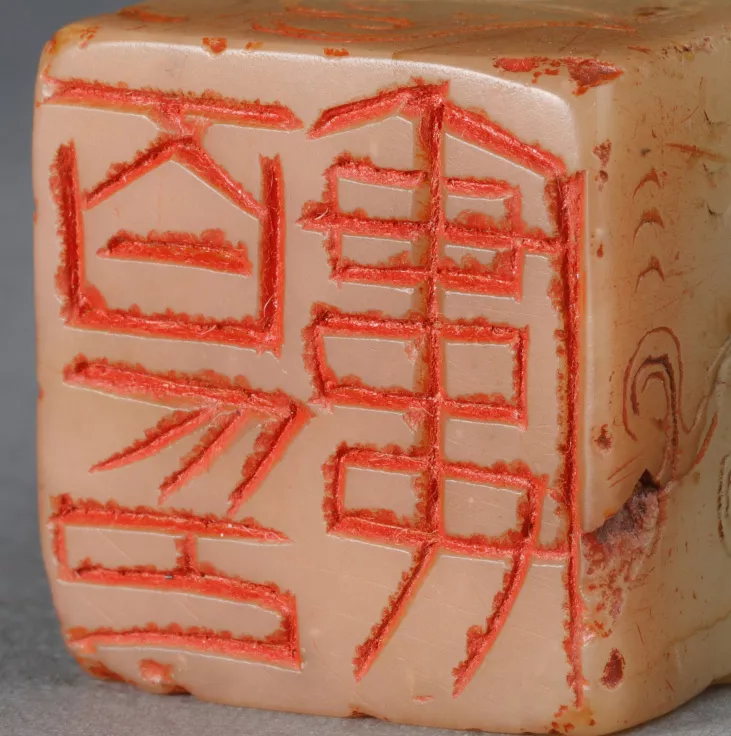
Seal carving uses lines to shape the characters and the frame of the seal. Chinese characters inherently possess the characteristic of "form beauty evoking feeling," and seal script is even richer in formal beauty, but it cannot replace seal carving. The seal carver must go through the process of writing and carving: writing is the design of the draft, the foundation; carving is the realization and refinement using the knife. In the design phase, lines should be flexibly used in terms of length, slope, and thickness. The main lines in seal script are horizontal straight lines, giving an ancient and profound feel; Yuan Zhu Wen combines long and short curves, creating a round and vigorous, delicate beauty; Qi Baishi is skilled at using diagonal lines, which are sharp and clear. Excellent drafts often require repeated revisions. The technique of the knife is decisive in determining the texture of the line. The broken, dry-moist, discontinuous, and hidden effects left by the knife on the stone are the unique effects of seal carving. If one only uses the knife to copy the written lines, it becomes a reproduction of calligraphy. The technique must be in harmony with the hand, employing methods such as merging, cutting, and carving, and utilizing the slight crumbling of the stone to make random selections, thus achieving a natural charm. The knife and the brush coexist; it is neither "only the knife technique is supreme" nor "only the brush and ink are sought."
The frame of the seal is also a factor of formal beauty. The square shape best utilizes space, so most seals are square. The frame constrains the arrangement of the characters, keeping the form simple, and it is difficult to express powerful momentum. A successful frame should have a texture consistent with the character lines, be full of spirit, and not be a boundary but an extension, blending with the sparse and dense, the empty and the full, with broken and straight lines appearing randomly. Wu Changshuo skillfully uses stacked, borrowed, and broken edges to create a majestic and extraordinary effect; Huang Mufu's inscription edges are strangely straight and bright; Zhao Guni takes the seal clay edge as a frame, giving it an ancient and rustic feel; Chen Julai is round and vigorous, elegant and restrained; Lai Chu makes the frame and characters appear as if they are faintly visible, becoming one with each other. This is the highest requirement for the beauty of the frame line.
Wu Qiaoyan's "Thirty-Five Examples" is the earliest discussion on the beauty of lines, advocating for a square and straight style in Chinese and seal script, opposing arbitrary curves, and playing a major role in correcting errors, but later it became a dogma that limited later generations. The Chinese and seal script style with straight lines, horizontal lines, strict squareness, and symmetrical order forms a level, solemn, and ancient and profound style, which is the paradigm of seal carving formal beauty and reached the first peak in seal history. However, aesthetic tastes are changing, and the Chinese and seal script style is not the only model. The styles of the Six Dynasties, Tang, and Song pursued fluidity, round turns, and romantic expansiveness. Ding Jing once praised: "The ancients of the Six Dynasties and Tang and Song thought of departure, rolling and unfolding together on the mountains and clouds. Seeing the wonders of the Six Dynasties, Tang and Song, how could we cling to the Han style?" Change is the driving force of artistic progress. With the rise of Ming and Qing schools, various lines were incorporated into seals, opening up new eras. Seeking change must affirm, but innovation cannot exclude excellent tradition. The reason for the low point in seal studies after the Han until the mid-Ming Dynasty was complex. An important lesson is that innovation should not discard tradition simultaneously.