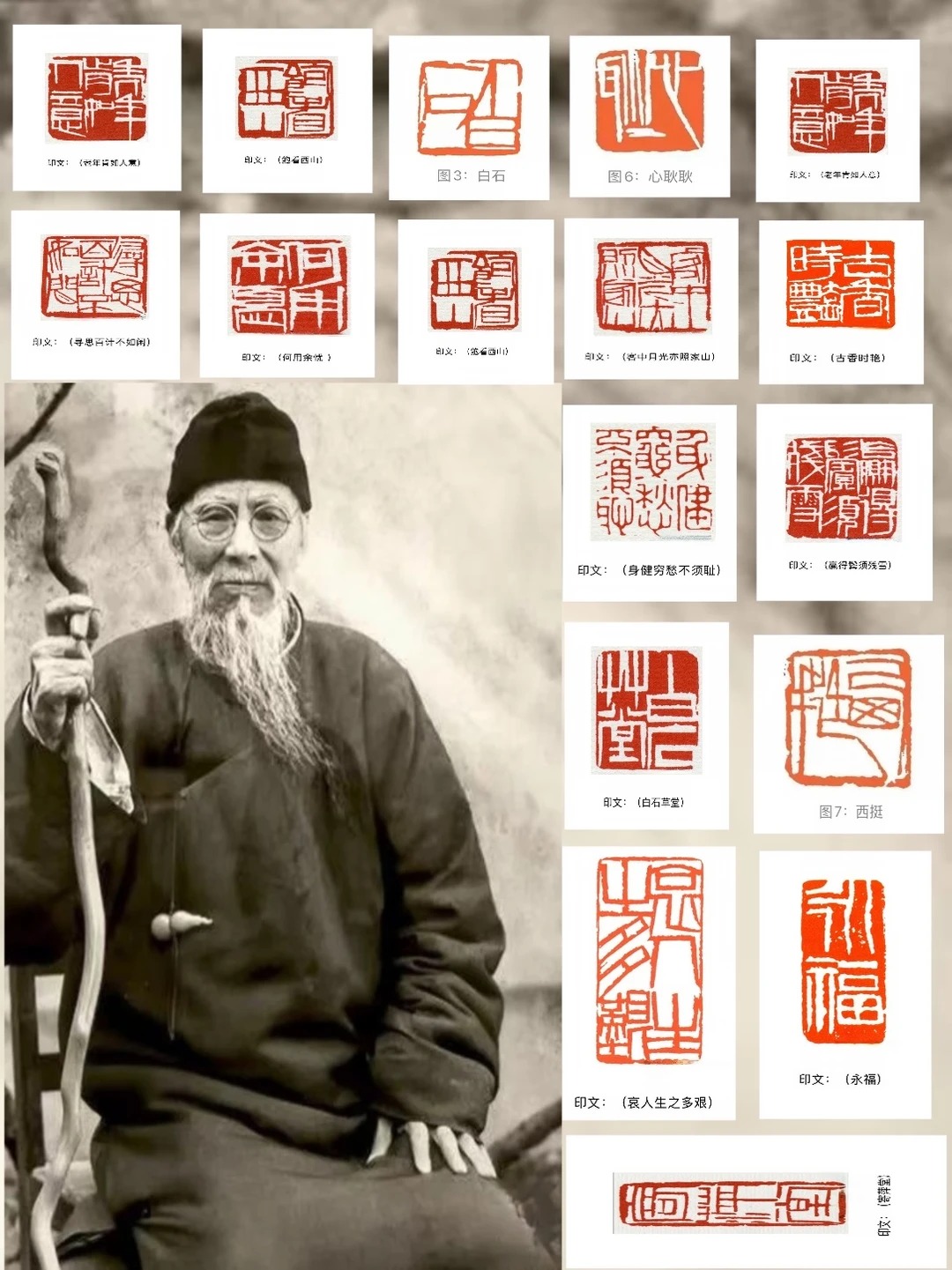
Appreciating Qi Baishi's seals is not about judging neatness; it's about seeing the vitality bursting forth between the blade and the stone. He is famous for his "single stroke straight in": one cut, no revision, the line is both light and hairy, breaking naturally, resulting in a refreshing, spicy, and vast quality—possessing both the "taste of the blade" and the "taste of the stone." When looking at the technique, pay attention to his boldness, rhythm, and sharpness in the stroke, to experience the calligraphic sense of "using the blade instead of the brush."
Then look at the composition. Qi Baishi is skilled at grand openings and closings; where there is space, there is room for a horse to gallop, and where it is dense, there is no place for the wind to enter. Characters often interlace and yield to each other, sometimes deliberately breaking or borrowing the edge, making the seal surface奇险 (extraordinary in its complexity) yet not scattered. In terms of character form, he transforms circles into squares, drawing inspiration from seal scripts and clerical scripts, absorbing the essence of Han seals, official documents, and imperial edicts. They are square and rugged, showing skill within rawness, not pursuing neat sweetness.
Finally, read the text and the atmosphere. His inscriptions, such as "Under the Master of Lu Ban," "Wood Dweller Scholar," and "Three Hundred Stone Seal Rich Man," carry self-deprecation, confidence, and a touch of life, revealing his background, experiences, and temperament. When appreciating, first take in the overall aura, then look closely at the lines and strokes, and finally read the inscription and the edge markings to feel his spirit of "daring to create uniquely." Qi Baishi's seals are wonderful in their ambiguity: not sweet, not familiar, not flattering, but exhilarating and full of whimsy.